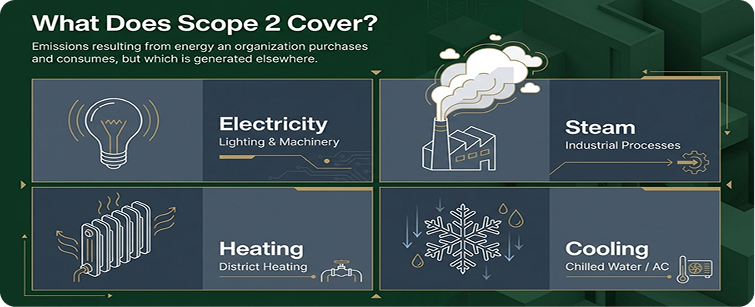
In the carbon footprint accounting, emissions are divided into three scopes; while Scope 1 focuses on emissions produced directly by the facility, and Scope 3 focuses on emissions associated with the value chain, Scope 2 focuses on emissions resulting from energy that an organization purchases and consumes but is generated elsewhere (such as a power plant).
Scope 2 Emission Sources
Scope 2 includes four main types of purchased energy:
- 1. Electricity: The most common source (used for lighting and operating equipment and machinery).
- 2. Steam: Used in industrial processes.
- 3. Heating: Such as district heating networks.
- 4. Cooling: Such as chilled water used in central air conditioning systems.
Emissions here are 'indirect emissions' because they are released from the smokestack of the power generation plant, not from the chimneys of furnaces or boilers inside your company; however, you are responsible for those emissions as the 'end consumer'.
Keep scrolling
Why is Scope 2 calculation mandatory despite being indirect emissions?
It is calculated mandatorily for several reasons:
- Ease of measurement: Calculations rely on monthly consumption invoices (kWh), which are accurate and consistently available data.
- Speed of impact: Once transitioning to a renewable energy source, this scope immediately drops to zero.
- Control: The organization has full control and the ability to reduce its consumption of those emissions.
Keep scrolling
Methods for calculating Scope 2 emissions:
Scope 2 emissions are calculated using one of two methods:
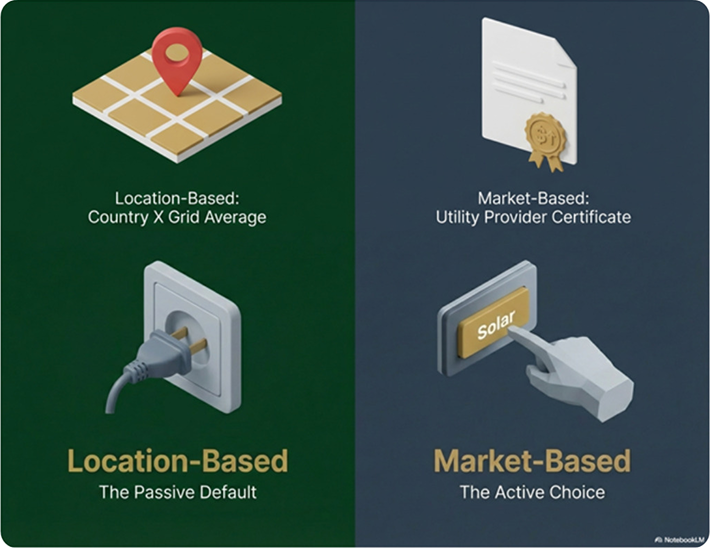
- Location-based method: It relies on the average greenhouse gas emissions from the national electricity grid in the region where the project is located (for example, operating in Country X where electricity production results in greenhouse gas emissions of 0.5634 kg CO₂e/kWh).
- Market-based Method: This method is applied when the facility has options regarding the purchase of electricity from a specific provider—for instance, a provider using natural gas or one relying on solar panels (Emission Factor = 0). It is also used when the greenhouse gas (GHG) emissions data related to the electricity consumed by the company is documented and specified in a certificate from the utility provider.
For example, a utility company may offer different electricity tariffs based on the type of fuel used in production; subsequently, the facility might purchase 50% of its consumption from electricity certified as diesel-generated, 30% from electricity generated using natural gas, and 20% from electricity produced via solar panels.