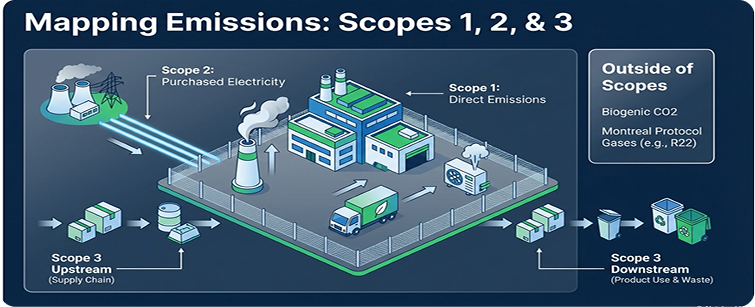
The GHG Protocol Corporate Standard is the most widely recognized global reference for assessing and managing corporate greenhouse gas emissions. It categorizes emission sources into three distinct 'Scopes' to ensure accuracy and prevent double counting:
- Scope 1 (Direct Emissions): Emissions from sources that are owned or controlled by the organization.
- Scope 2 (Indirect Energy Emissions): Emissions from the generation of purchased electricity, steam, heating, and cooling consumed by the organization.
- Scope 3 (Other Indirect Emissions): Emissions that occur in the organization's value chain, including suppliers, waste disposal, and business travel.
Keep scrolling
Scope 1 Emission Sources
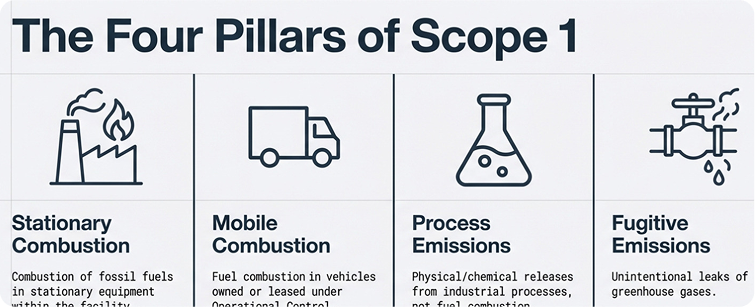
Scope 1 is divided into four main categories covering all of the organization's operational activities:
1. Stationary Combustion
This includes emissions resulting from the combustion of fossil fuels in stationary equipment within the facility, such as boilers, furnaces, and electricity generators.
2. Mobile Combustion
These emissions result from fuel combustion in transportation vehicles and equipment owned by the organization (or leased under Operational Control), such as company cars for employees and trucks for transporting raw materials or products.
If transportation is handled by third-party providers (Outsourced), these emissions are classified under Scope 3 as indirect value chain emissions.
3. Process Emissions
These are physical or chemical emissions released directly from industrial processes (rather than fuel combustion), such as CO₂ generated during cement manufacturing or aluminum production.
4. Fugitive Emissions
These represent unintentional leaks of greenhouse gases. Monitoring this category requires high precision to ensure the principle of Completeness in carbon footprint reporting.
Keep scrolling
Types of Fugitive Emission Sources
Fugitive emissions originate from various sources, including:
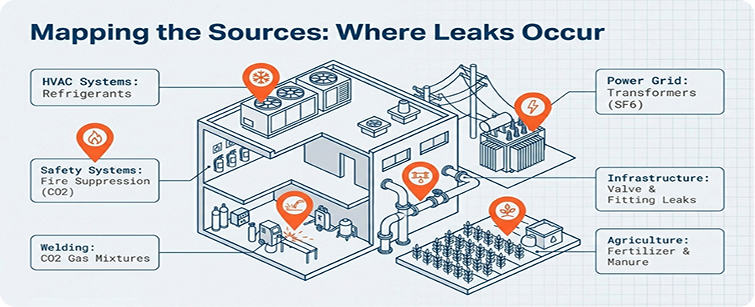
HVAC Systems (Heating, Ventilation, and Air Conditioning): These may leak refrigerants.
Gases regulated under the Montreal Protocol (such as R22) must be reported separately as "Outside of Scopes."
Fire Suppression Systems: Potential leaks of CO₂. Although its Global Warming Potential (GWP) is 1, it must be included to fulfill the completeness principle of the emission inventory.
Welding Activities: These produce CO₂; however, it is important to note that welding gas mixtures may contain CO₂ concentrations of only 20% or less.
Agricultural and Livestock Emissions: Including methane (CH₄) from Enteric Fermentation, Manure Management, and emissions related to the use of nitrogen-based fertilizers.
Industrial Leaks: Such as CH₄ leaks from valves and fittings in the Oil & Gas sector, or Sulfur Hexafluoride (SF₆) leaks from electrical transformers (SF₆ is considered one of the most potent GHGs with a GWP of 23,500).