Greenhouse gases (GHGs) comprise a group of both naturally occurring and synthetic gases. While natural gases were present in the atmosphere in small quantities before the Industrial Revolution, human activities have significantly increased their emissions.
The group greenhouse gases:
1. Carbon dioxide (CO₂):
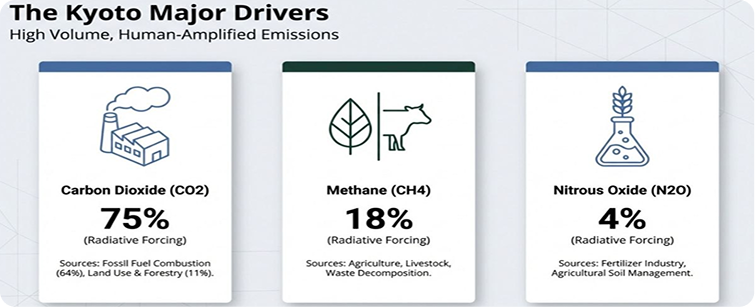
Carbon dioxide is responsible for approximately 75% of the total greenhouse gas radiative impact. The vast majority of this (around 64%) comes from the burning of fossil fuels and industrial processes.
2. Methane (CH₄):
Methane contributes approximately 18% of the total greenhouse gas radiative impact, according to the latest estimates from the Intergovernmental Panel on Climate Change (IPCC). Methane is primarily produced from agricultural activities.
3. Nitrous oxide (N₂O):
This gas accounts for 4% of the radiative impact and is primarily produced in the fertilizer industry.
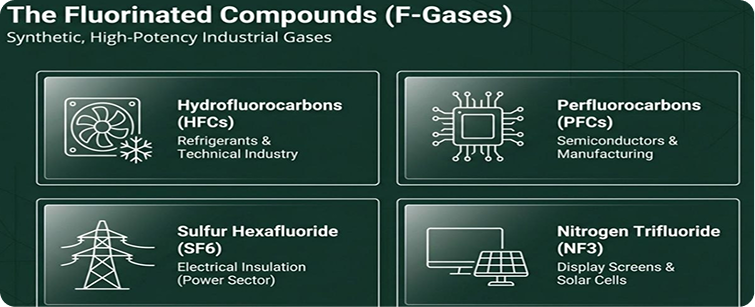
The remaining percentage is attributed to manufactured gases known as fluorinated compounds, due to the presence of fluorine in their basic composition. These include:
4. Hydrofluorocarbons (HFCs):
These compounds are used as refrigerants and in various technological industries.
5. Perfluorocarbons (PFCs):
These are also used as refrigerants and in various technological industries.
6. Sulfur hexafluoride (SF₆):
This gas is used as an insulator in the electrical sector.
7. Nitrogen trifluoride (NF₃):
This gas is used in the production of flat panel displays and solar cells.
Keep scrolling
Keep scrolling
Excluded gases:
1. Chlorofluorocarbons (CFCs) and hydrochlorofluorocarbons (HCFCs):
These compounds are not only greenhouse gases, but they are also ozone-depleting compounds in the stratosphere, threatening life on Earth due to increased ultraviolet (UV) radiation. Therefore, the Montreal Protocol was concluded in 1989 to limit the production.
GHGs covered by the Montreal Protocol are reported in carbon footprint reports as 'Outside of Scopes'.
2. Water Vapor:
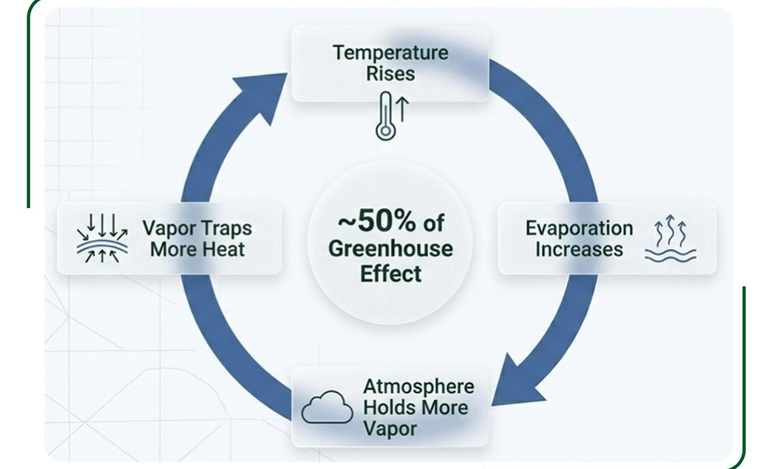
Although it is responsible for about 50% of the greenhouse effect, it is not a primary driver of this phenomenon
For two reasons:
a) Its increase is a consequence, not a cause. A one-degree Celsius increase in atmospheric temperature leads to a 7% increase in water vapor, according to the laws of thermodynamics. This creates a positive feedback loop that further warms the planet. If emissions of other greenhouse gases were to cease, water vapor would return to its natural levels.
b) Water vapor is the only greenhouse gas that condenses. As soon as the temperature drops, it turns into a liquid. Therefore, the average lifespan of a water vapor molecule in the atmosphere does not exceed nine days, unlike other well-mixed greenhouse gases that have long lifespans. Methane has a lifespan of about 7 years, nitrous oxide 116 years, and some fluorinated compounds can have lifespans of hundreds or thousands of years.
3. Ozone Gas:
First, it is important to distinguish between ozone emissions in the troposphere, which are harmful to health (Bad Ozone), and ozone in the stratosphere (Good Ozone), which protects the Earth from ultraviolet radiation. It should be noted that ozone acts as a greenhouse gas in both cases.