
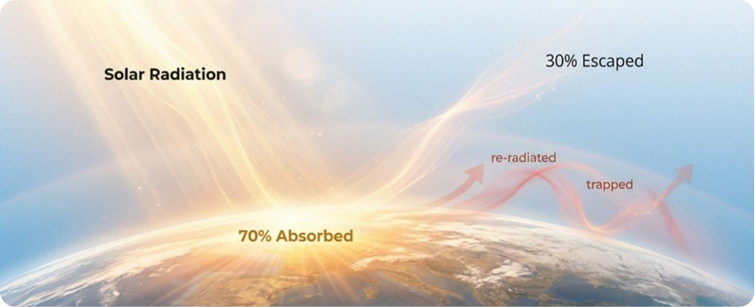
The sun is the primary source of energy on Earth. When its rays reach us, about 30% of them are immediately reflected back into space upon encountering the atmosphere or the Earth’s surface, while the remaining 70% is absorbed. This absorbed energy is then re-emitted as infrared (IR) radiation. While some of it escapes into space, the rest is absorbed by greenhouse gases, which re-radiate it in random directions—returning some to the surface, converting some into other compounds, and allowing the rest to dissipate.greenhouse gases, which re-radiate it in random directions—returning some to the surface, converting some into other compounds, and allowing the rest to dissipate.
Keep scrolling
So, is the presence of these greenhouse gases positive or negative?
Without greenhouse gases, life on Earth would be impossible, as all of the sun’s energy would be lost to space, and the planet would freeze. However, the presence of greenhouse gases maintains Earth’s warmth at levels that allow life to continue. To illustrate this point.
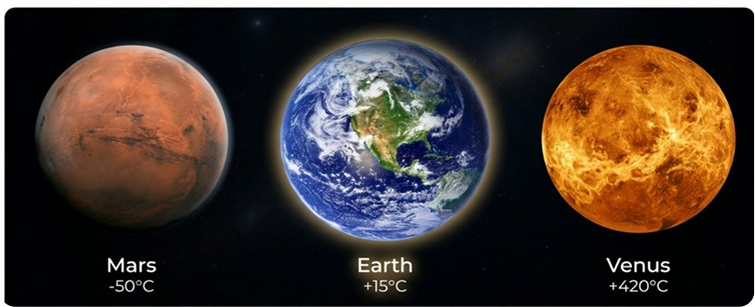
let’s compare the planets:
- Venus's atmosphere is composed of 95% carbon dioxide, resulting in an average surface temperature of 420 degrees Celsius!
- In contrast, Mars has almost no carbon dioxide, causing its average surface temperature to plummet to -50 degrees Celsius.
- Our planet, Earth, has an atmosphere composed of 78% nitrogen and 20.9% oxygen. The remaining 1% is a mixture of several gases, including 0.03% carbon dioxide. This delicate balance is what keeps Earth's average temperature at 15 degrees Celsius. Without this small concentration, the average temperature would be -20 degrees Celsius!
Keep scrolling
Then, where is the problem?
While the presence of greenhouse gases is fundamentally a natural balance essential for life, the crisis began with the Industrial Revolution and intensive human activities. Although the solar radiation reaching Earth and the heat released from its surface remained constant, the concentration of greenhouse gases rose dramatically. This imbalance trapped excessive heat, preventing it from escaping into space and leading to global warming—a phenomenon causing severe climatic shifts that impact all living organisms.