Carbon footprint management is a fundamental pillar of modern sustainability strategies. It enables organizations to quantify their climate change impact and develop targeted reduction plans based on international standards. The management process consists of six integrated, methodical stages:
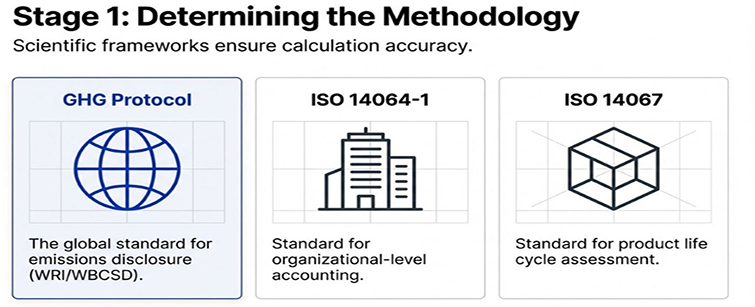
Determining the Methodology
The process begins by selecting a scientific framework to ensure calculation accuracy. The Greenhouse Gas Protocol (GHG Protocol)—developed by the World Resources Institute (WRI) and the World Business Council for Sustainable Development (WBCSD)—is the leading choice, offering comprehensive guidance for emissions disclosure. Additionally, ISO 14064-1 serves as a parallel methodology for organizational-level accounting, while ISO 14067 is utilized to assess the carbon footprint of products throughout their life cycle.
Keep scrolling
Defining Organizational & Operational Boundaries
This stage requires high precision to prevent double-counting or under-counting emissions. It includes:
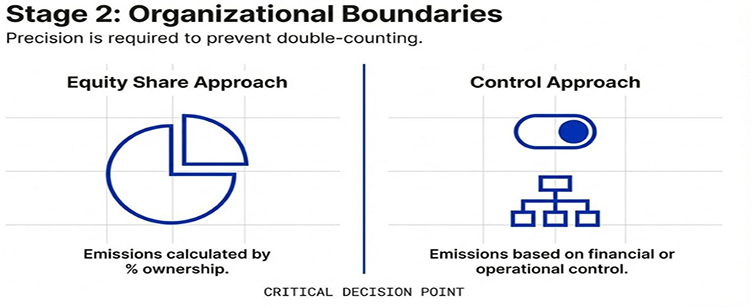
Organizational Boundaries:
Determined using either the Equity Share approach, where emissions are calculated based on ownership percentage, or the Control approach, which accounts for emissions based on financial or operational control.
Operational Boundaries:
According to the GHG Protocol, emissions are categorized into three scopes:
- Scope 1: Direct emissions from sources owned or controlled by the organization.
- Scope 2: Indirect emissions from the generation of purchased energy (e.g., electricity).
- Scope 3: All other indirect emissions across the value chain, from raw material extraction to end-of-life disposal.
Keep scrolling
Data Collection and Collation
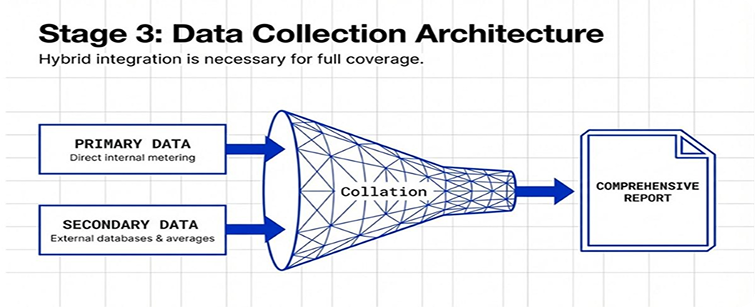
The quality of the final report depends on the data collection mechanism. Data is classified into two types:
Primary Data
Direct data collected internally from the organization or facility.
Secondary Data
Obtained from external sources, such as supply chain partners, national industry averages, or global databases. Integrating both types is a practical necessity to ensure comprehensive coverage of all activities.
Keep scrolling
Emission Calculation
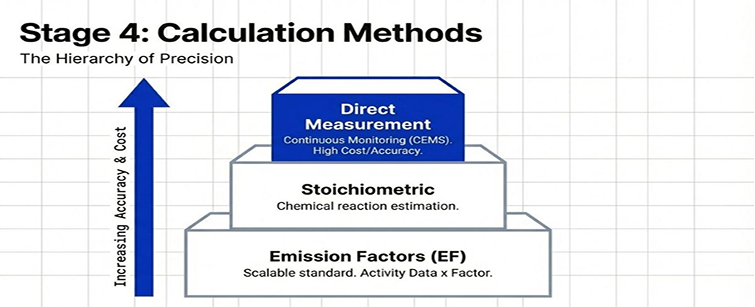
Calculation methods vary based on available data accuracy:
Direct Measurement
Utilizing Continuous Emission Monitoring Systems (CEMS). While highly accurate, it is costly and difficult to apply across all GHG sources.
Stoichiometric Calculation
Estimating emissions based on chemical reactions and production mass balance.
Emission Factors (EF)
The most common method, where Activity Data (e.g., annual fuel consumption) is multiplied by a specific Emission Factor. An EF is an estimate relating the quantity of GHG released to the atmosphere with the intensity of an activity. It converts raw activity data into CO2e (Carbon Dioxide Equivalent).
Activity Data (unit/year) × Emission Factor (kg CO2e/unit) = GHG Emissions (kg CO2e)
Keep scrolling
Verifying the Results
This stage serves as a quality management measure to ensure credibility. Although verification by an accredited third party may not be mandatory in all contexts, it provides regulatory bodies and investors with confidence in the report's reliability.

Keep scrolling
Mitigation Planning
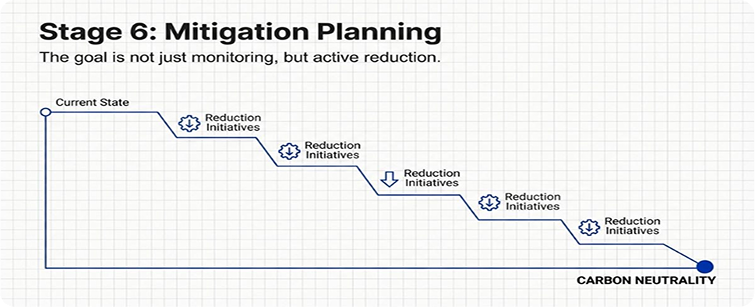
The ultimate goal of carbon footprint accounting is to actively reduce emissions rather than merely monitoring them. Following the report's issuance, the organization develops a clear roadmap to achieve Carbon Neutrality.