In greenhouse gas (GHG) emissions inventorying according to the Greenhouse Gas Protocol methodology, emissions are divided into three main scopes:
- Scope 1 Emissions
- Scope 2 Emissions
- Scope 3 Emissions
However, there are certain emissions that cannot be included within these scopes when preparing a corporate carbon footprint. These are technically known as 'Outside of Scopes Emissions'. This does not mean that these emissions are non-existent or climatically unimportant; rather, it means they are not calculated within the established Organizational & Operational Boundaries of the facility for reasons that vary depending on the emission sources. In this article, we will examine the two most important examples of emissions disclosed outside the three scopes:
Keep scrolling
Refrigerant Gases: Between Ozone Depletion and Climate Change
The older generation of refrigerant gases primarily included Chlorofluorocarbons (CFCs), such as R11 and R12. Their impact on both the ozone layer and climate change was extremely high. For example, for R12 gas:
- .Ozone Depletion Potential (ODP) = 1.0
- .Global Warming Potential (GWP) = 12,500
Subsequently, Hydrochlorofluorocarbons (HCFCs), including R22, emerged as alternatives to reduce impacts on the ozone layer. For example, for R22 gas:
- .Ozone Depletion Potential (ODP) = 0.055
- .Global Warming Potential (GWP) = 1,960
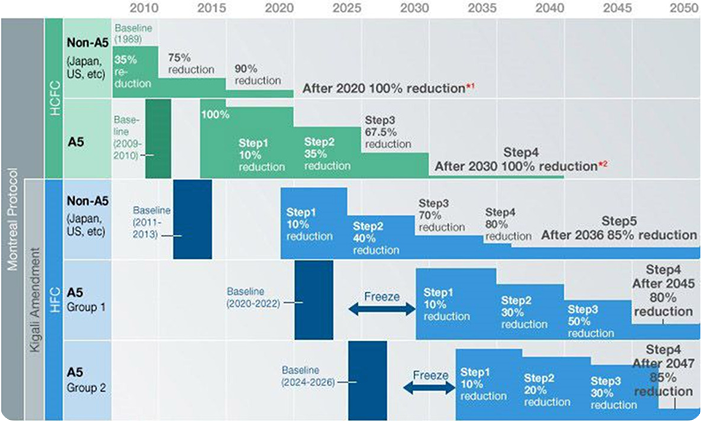
Although HCFCs are better than CFCs, they still affect the ozone layer. Consequently, the Montreal Protocol mandated the gradual phase-out of both. The production and consumption of CFCs were completely banned in developed countries (Non-A5 Parties) as of 1996 and in the rest of the world as of 2010. HCFC production and consumption were banned in developed countries as of 2020. In the rest of the world, production is still permitted but at a rate lower than 67.5% of the baseline years (2009–2010), with a full ban expected by 2030. For this reason, R22 is still produced in many countries and is commonly used in air conditioning units.
Later, Hydrofluorocarbons (HFCs), such as R410 and R134, emerged as environmentally friendly alternatives (in terms of having no negative impact on the ozone layer) and their global use began to increase. However, they still significantly impact climate change. For example, for R410a gas:
- .Ozone Depletion Potential (ODP) = 0
- .Global Warming Potential (GWP) = 1,924
Due to the high impact of HFCs on climate change, they were included in the Kigali Amendment to the Montreal Protocol and fall under the scope of the Kyoto Protocol (unlike CFCs and HCFCs, which were previously covered under the Montreal Protocol).
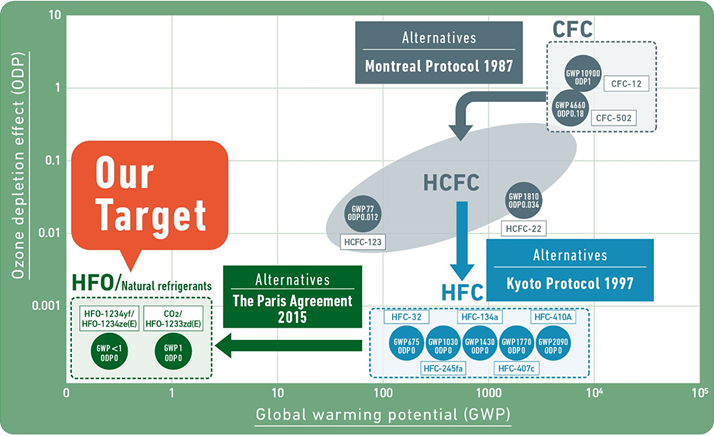
Note: When calculating a carbon footprint, Hydrofluorocarbons (HFCs) are included under Scope 1 emissions. In contrast, emissions from compounds subject to the Montreal Protocol (including the commonly used R22 gas) are calculated and reported as a fourth category called 'Outside of Scopes'.
Keep scrolling
Using Biofuels as an Energy Source
Consider a company that relies on diesel to generate energy in its facility. The manager decides to transition to Bio-ethanol to reduce their carbon footprint. The question is, how will this switch appear in the carbon footprint report?
The combustion of bio-ethanol produces three greenhouse gases:
- .Carbon Dioxide (CO₂)
- .Methane (CH₄)
- .Nitrous Oxide (N₂O)
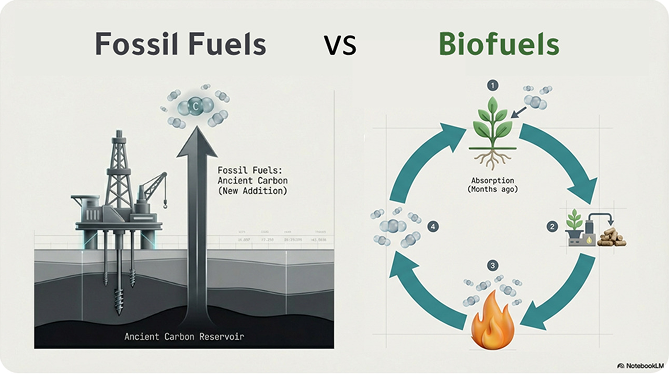
Carbon dioxide released when burning bio-ethanol is treated as biogenic CO₂: carbon that was recently removed from the atmosphere by biomass growth. It is typically reported separately as "Outside of Scopes" rather than added again as a fossil emission.
Methane and nitrous oxide formed during combustion are regarded as non-biogenic additions from the process itself and are included in Scope 1 totals alongside other operational releases.
Emissions linked to producing and transporting the biofuel—before it reaches your facility—fall under Scope 3, commonly mapped to Category 3 (fuel- and energy-related activities not already captured in Scopes 1 or 2).